

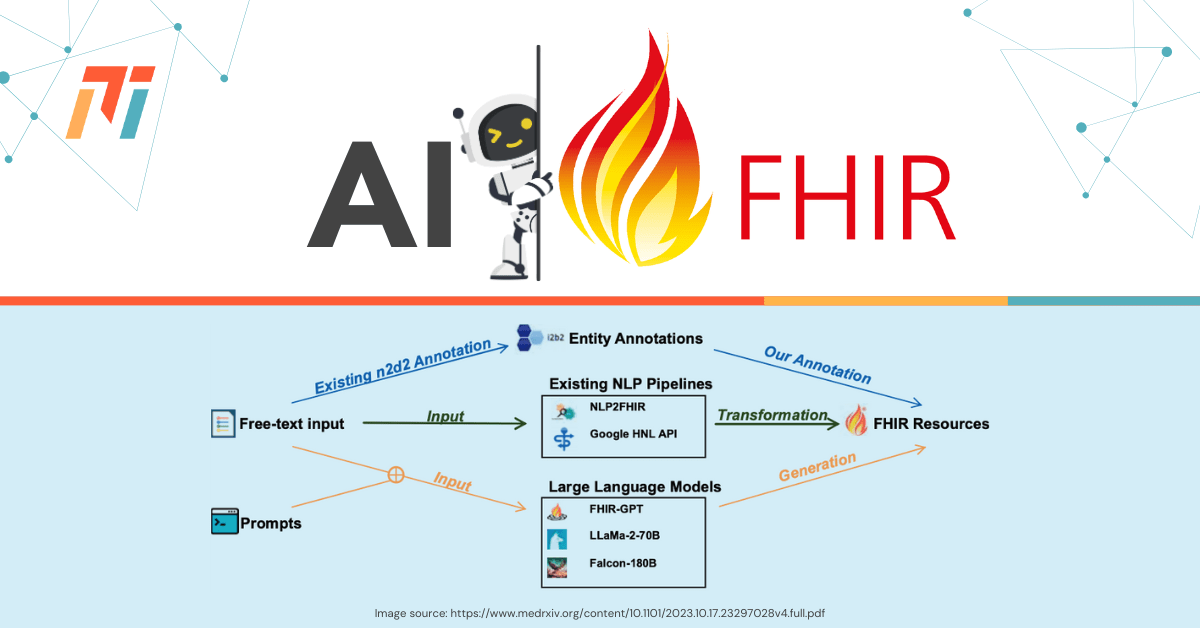
Researchers at Northwestern Medicine have developed a new AI model, FHIR-GPT, that leverages the power of large language models (LLMs) to convert clinical data into Fast Healthcare Interoperability Resources (FHIR). This breakthrough, detailed in a study published in NEJM AI , showcases how FHIR-GPT achieved an impressive 90% success rate in matching clinical texts to FHIR medication statements, outperforming existing tools.
According to the study, FHIR-GPT not only excelled in accuracy but also enhanced the exact match rates of current NLP pipelines by notable margins:
“With LLMs, we can convert clinical data into a standardized format, which allows for the creation of larger datasets and easier communication across healthcare stakeholders,”
Yikuan Li, lead author of the study
- 3% for medication administration routes,
- 12% for dose quantities,
- 35% for reasons behind medication administration,
- 42% for medical forms,
- and over 50% for medication timing schedules.
“This will significantly speed up breaking down barriers between health systems that block data aggregation and exchange, which is crucial for large-scale research, particularly with the advancements in generative AI and LLM technology,” said Luo, associate professor of Preventive Medicine in the Division of Health and Biomedical Informatics, director of the Center for Collaborative AI in Healthcare, and senior author of the study.
To achieve these results, more than 3,600 clinical texts were manually annotated and then used to prompt GPT-4, a large language model developed by OpenAI.
“With LLMs, we can convert clinical data into a standardized format, which allows for the creation of larger datasets and easier communication across healthcare stakeholders,” added Yikuan Li, lead author of the study and a fifth-year student in the Health Sciences Integrated Ph.D. Program.
FHIR-GPT and the challenge of interoperability
The authors emphasized the importance of health data interoperability not only for improving patient care but also for achieving health equity, particularly in responding to public health emergencies.
To accelerate the exchange of critical data, U.S. federal agencies such as the Office of the National Coordinator for Health Information Technology, the CDC, and the Centers for Medicare & Medicaid Services have facilitated the adoption of the FHIR standard.
“FHIR is like a universal language for healthcare data, much like English is for international communication. When hospitals implement FHIR, they can share and interpret each other’s data more efficiently, leading to better collaboration and patient care,” Luo explained.
Despite this progress, transforming health data into FHIR resources remains a challenge due to the diverse infrastructures, standards, and formats used by health organizations across the U.S. and Europe.
Meditecs aims to address these challenges by offering a comprehensive solution for health data interoperability. Through MT Smart Connect technology, Meditecs ensures the cost-effective implementation of interoperability projects across a variety of standards, including FHIR, HL7 V2.X, ASTM E1381, DICOM, and IHE Profiles. Find out today how to implement this technology in your organization.

